

Helene’s Aftermath: The Economic Wreckage Behind the Storm

As Hurricane Helene battered the Southeast United States in late September 2024, it left more of an impact than just wrecked trees and flooded roads. The Category 4 hurricane destroyed western North Carolina, sections of Georgia, eastern Tennessee, and the Florida Panhandle, uprooting hundreds of thousands from their homes and bringing economic activity to a halt in numerous important metropolitan areas. The economic destruction is just beginning to come into focus.
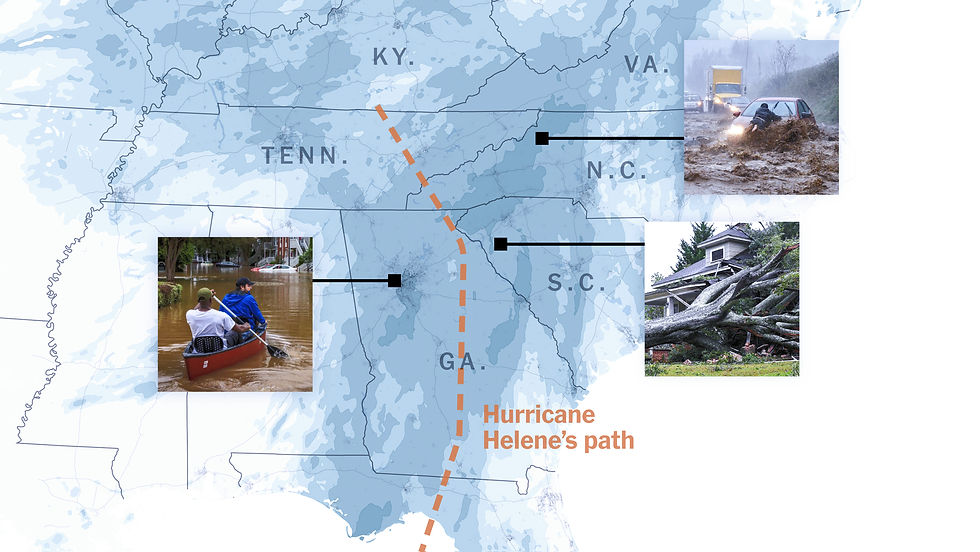
Immediate Losses
North Carolina suffered most from Helene's fury, with initial estimates placing damages at $53 billion, a record in state history. Landslides, destroyed homes, and loss of infrastructure hit more than 126,000 residences, with about 220,000 families in need of federal help. Factoring in rebuilding infrastructure, mitigation, and repair of government property, overall regional recovery requirements amount to over $59 billion.
In Florida's Panhandle, the storm resulted in flooding, wind damage, and scattered loss of power. While less widespread than in North Carolina, communities also felt economic disruption, cost of cleanup, and impact on infrastructure. (Cooper, 2024, Hagen et al., 2025)
Effects Across Industries
Energy Markets: Lowering power outages, more than 4 million customers, interrupted supply chains and increased wholesale electricity costs in the Southeast. Gasoline shortages followed as pipelines closed, fueling higher gasoline prices throughout the region.
Agriculture: Georgia and South Carolina soybean and cotton producers reported catastrophic losses just weeks from harvest time. Crop insurance will likely not pay for the scope of the loss, so rural economies could see long-term contraction.
Tourism & Services: Shutdowns of the airports, resorts, and seaports during the high-end fall tourist season underscore vulnerable character of service-based economies in hurricane zones. Experts estimate Florida's potential loss at $1.5 billion in tourism revenue this quarter.
A Test of Resilience
Economically, such catastrophes as Helene demonstrate the link between short-run shock and long-run resilience. The storm accelerates out-migration from riskier coastal areas, strains municipal bond markets that fund rebuilding, and burdens already strained federal disaster assistance funds that have been being stretched by wildfires in the West.
This process tends to be described by economists through the prism of creative destruction: rebuilding creates employment and capital, but exacerbates inequality, as poor households barely recover without sufficient insurance or buffers. Federal flood insurance reform, infrastructure resilience expenditures, and business climate risk disclosures trail Hurricane Helene.
Helene is not just a natural disaster: it is an economic force that's remaking whole industries, from insurance to farming. As climate change amplifies the storms, the real cost of hurricanes is not in the destruction of property, but in the out-of-proportion recovery that follows.
Writing Sources
Kumar, A., Chaia, A., & White, O. (2024, October 30). Assessing the impact of Hurricanes Helene and Milton on small businesses. McKinsey & Company. https://www.mckinsey.com/industries/public-sector/our-insights/assessing-the-impact-of-hurricanes-helene-and-milton-on-small-businesses
Fernandez, N. (2024, November 2). The Aftermath of Hurricane Helene – UAB Institute for Human Rights Blog. Uab.edu. https://sites.uab.edu/humanrights/2024/11/02/the-aftermath-of-hurricane-helene/
Hagen, A., Cangialosi, J., Chenard, M., Alaka, L., & Delgado, S. (2025). Hurricane Helene. https://www.nhc.noaa.gov/data/tcr/AL092024_Helene.pdf
Cooper, R. (2024). Hurricane Helene Recovery Recommendations Preliminary Damage and Needs Assessment. https://www.osbm.nc.gov/hurricane-helene-dna/open
Figure 1
Bora Erden, Kim, J., Shao, E., & White, J. (2024, September 29). Hurricane Helene: Mapping More Than 600 Miles of Devastation. Nytimes.com; The New York Times. https://www.nytimes.com/interactive/2024/09/29/us/helene-path-map.html
Cover Image
The Aftermath of Hurricane Helene: Assessing the Damage and Impact- Blog. (2024). Cajun Encounters. https://www.cajunencounters.com/blog/the-aftermath-of-hurricane-helene


Comments